
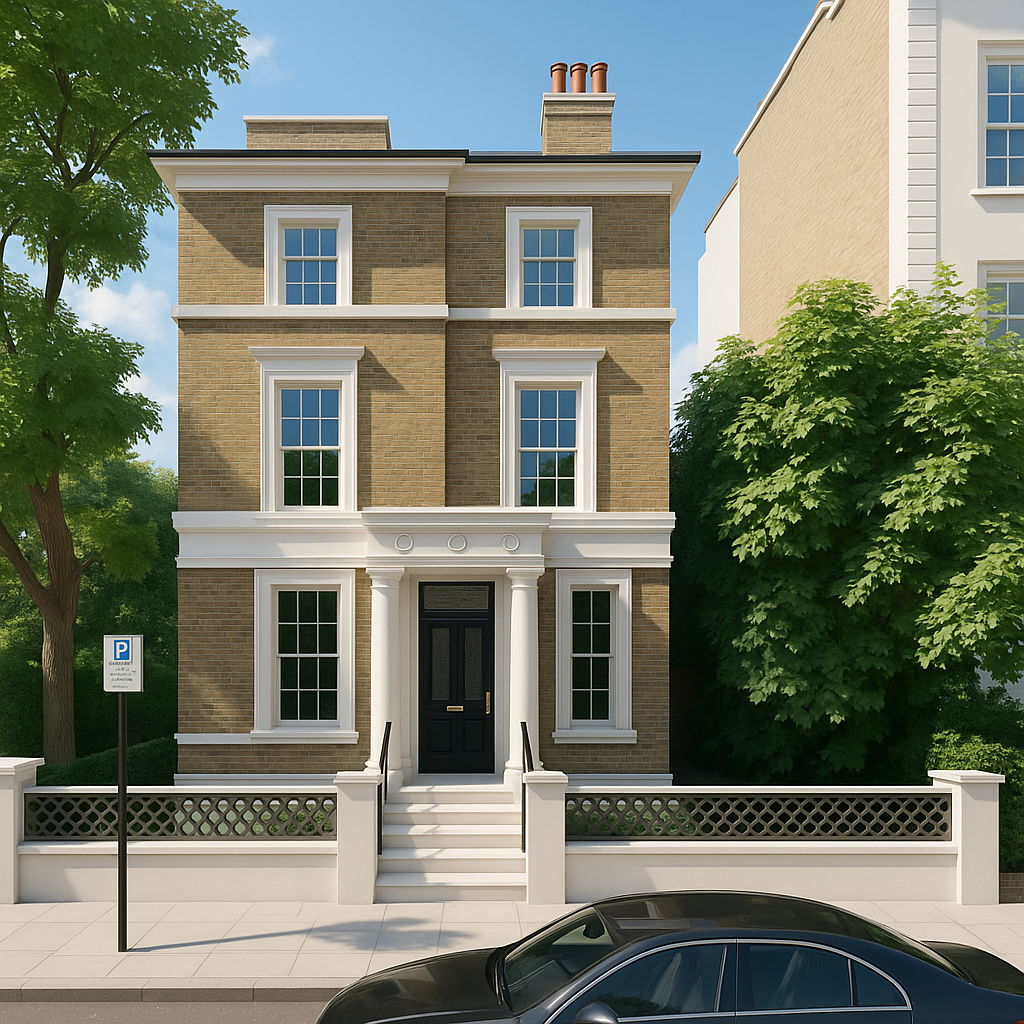
Project Overview
Vision Energy was appointed to develop the energy and sustainability strategy for a London-based residential scheme involving both new-build and refurbishment elements. The design team set out to exceed planning and building regulation targets, with a clear focus on practical carbon reduction and future-proofed energy solutions.
Objectives
- Achieve on-site carbon reductions aligned with local policy.
- Maximise building performance through fabric-first principles.
- Integrate appropriate low-carbon and renewable energy technologies.
- Ensure flexibility for future energy infrastructure, including district heat networks.
Strategy and Implementation
Vision Energy applied the Greater London Authority’s energy hierarchy Be Lean, Be Clean, Be Green as a framework to reduce energy demand and emissions at every stage. Key design choices were validated through SAP calculations and aligned with local planning requirements.
Energy Efficiency Measures
- Building fabric upgraded to deliver high thermal performance:
- Ground floor U-value: 0.13 W/m²K
- External walls: 0.18 W/m²K
- Roof: 0.13 W/m²K
- New glazing: U = 1.2 W/m²K
- High-efficiency lighting systems (120 lm/W) throughout.
- Mechanical Ventilation with Heat Recovery (MVHR) installed, delivering 91% efficiency and 0.55 SFP.
Renewable Energy Integration
- 6.4 kWp roof-mounted Solar PV system paired with a 4kW battery, enabling on-site generation and energy storage.
- All-electric heating and hot water systems specified to eliminate fossil fuel use.
- Site designed to be district heat-ready, should a local network become viable.
Environmental Performance Metrics
| Performance Indicator | Result |
| Baseline CO₂ emissions | 4.09 tCO₂/year |
| After energy efficiency (‘Be Lean’) | 2.99 tCO₂/year |
| After renewables (‘Be Green’) | 2.29 tCO₂/year |
| Total on-site carbon savings | 44% |
| Annual offset requirement (carbon gap) | 2.29 tCO₂ |
| SAP rating (new-build unit) | 84 (B) |
| DER (Dwelling Emission Rate) | 12.89 kgCO₂/m²/year |
| DFEE (Dwelling Fabric Energy Efficiency) | 38.42 kWh/m²/year |
| DPER (Dwelling Primary Energy Rate) | 73.91 kWh/m²/year |
Broader Sustainability Measures
- Flood mitigation: Green roof and water butt reduce surface water runoff by 6%.
- Overheating prevention: Passive ventilation, thermal mass, and orientation strategies used.
- Materials and embodied carbon: Focus on sustainably sourced and low-carbon materials.
- Waste and circular economy: Construction waste minimised through reuse and responsible disposal plans.
- Noise and operational resilience: All technologies assessed for acoustic impact and lifecycle performance.
Outcome
Vision Energy’s comprehensive strategy enabled the development to confidently meet and exceed sustainability goals. The project illustrates how early-stage, data-driven energy planning can be seamlessly embedded in residential development even within dense, constrained urban sites delivering long-term environmental and economic benefits.